

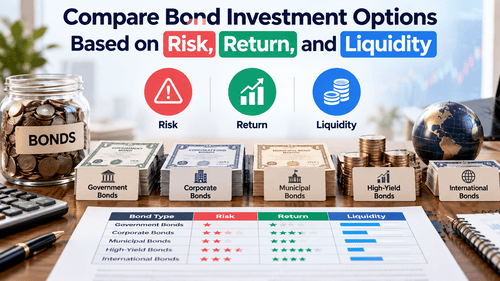
A diverse investing portfolio can benefit greatly from bond investments. The risk, return, and liquidity combinations offered by various bonds vary. These elements affect a bond’s performance in different market scenarios and whether it aligns with an investor’s financial goals. Investors can more successfully compare bond investment possibilities if they are aware of these evaluation criteria.
Understanding the Key Evaluation Parameters
Before you explore bond investment options, it is important to understand the factors that influence bond selection. Investors can assess whether a bond fits their financial objectives, investment horizon, and liquidity needs by looking at risk, return, and liquidity.
Risk
The probability that an investment will not perform as anticipated is referred to as risk. Risks associated with bond investments include fluctuations in interest rates, the issuer’s capacity to pay back debts, and restricted market liquidity. Before making an investment, investors can assess various bond options by being aware of these potential risks.
Return
Return represents the income or overall gain generated from a bond investment. It could involve principal repayment at maturity as well as recurring coupon payments. When assessing predicted returns, investors frequently compare coupon rates, yield, and investment duration.
Liquidity
The ease with which a bond can be purchased or sold prior to maturity is referred to as liquidity. In the secondary market, bonds with more trading activity are typically simpler to sell. Market demand and trading volume can influence the liquidity of different bond investments.
Comparing Bond Investments by Risk
Depending on the issuer and the state of the market, different bond investments have varying degrees of risk. Because they are backed by the Indian government, government-issued bonds often have a reduced credit risk. Because the issuing company’s financial stability affects repayment, corporate bonds may carry a larger credit risk.
Investors can evaluate an issuer’s ability to repay debt by using credit ratings. Higher-rated bonds are typically thought to carry less credit risk than lower-rated bonds. However, as credit ratings do not completely eliminate investment risk, they should be taken into account in conjunction with other variables.
Interest rate risk also differs across bond investments. Longer-maturity bonds are generally more sensitive to changing interest rates than shorter-term bonds. Investors should evaluate both credit risk and interest rate risk before selecting a suitable bond investment.
Evaluating Return Potential Across Bond Investments
Bond returns can vary depending on the issuer, coupon rate, maturity period, and prevailing market conditions. Government securities generally have higher trading activity, making them easier to buy and sell than many corporate bonds. Corporate bonds may provide higher yields to compensate investors for assuming additional credit risk.
It is also important to distinguish between the coupon rate and yield. The coupon rate represents the fixed interest calculated on the bond’s face value. Yield reflects the return based on the bond’s current market price and may change as market prices fluctuate.
Longer-term bonds may sometimes offer higher yields than shorter-term bonds. However, higher returns should always be evaluated together with the associated investment risks instead of being considered independently.
Evaluating Bond Investments by Liquidity market conditions.
Liquidity refers to how easily investors can sell a bond in the secondary market before maturity. Government securities generally have higher trading activity, making them easier to sell than many corporate bonds. However, liquidity can vary depending on the bond and prevailing market conditions.
Listed corporate bonds can also be bought and sold on recognised stock exchanges. However, trading volumes differ across issuers and individual bonds. As a result, some bonds may be more difficult to sell quickly or at the desired price before maturity.
Investors expecting to access their invested funds before maturity should consider liquidity alongside risk and return. Evaluating secondary market activity can help investors understand how easily a bond may be traded.
| Bond Type | Risk Level | Return Potential | Liquidity |
| Treasury Bills | Relatively low | Lower | High |
| Government Securities | Relatively low | Moderate | High |
| PSU Bonds | Low to moderate | Moderate | Moderate |
| AAA-rated Corporate Bonds | Moderate | Moderate to higher | Moderate |
| Lower-rated Corporate Bonds | Higher | Higher | Lower to moderate |
The Trade-Off Between Risk, Return, and Liquidity
Selecting a suitable bond investment involves balancing risk, return, and liquidity based on individual financial objectives. Investors seeking relatively stable investments may prefer lower-risk instruments, while others may have to accept higher risk when they explore corporate bond options for potentially higher yields.
When investors could require access to cash before to maturity, liquidity is equally crucial. Instead of concentrating solely on possible returns, investment selections should take into account financial objectives, anticipated holding periods, cash flow needs, and general risk tolerance.
Conclusion
When assessing bond investing choices, risk, return, and liquidity continue to be the essential considerations. Before making an investment selection, reputable platforms like Altifi assist investors in comparing various fixed-income products by examining their key characteristics. Investors can choose bonds that fit their financial objectives, investment horizon, and liquidity needs by carefully evaluating these criteria collectively.