
A mangalsutra is never just an accessory. It carries the weight of ritual, region, and personal history. Mangalsutra designs vary widely across India, shaped by local custom and craft. What looks traditional in Maharashtra might look unfamiliar in Punjab. That difference is the point, not an inconsistency.
Each state has built its own visual language around this piece of jewellery. Community customs and generations of quiet adaptation shaped these mangalsutra designs. Let’s explore how each region interprets this one symbol so differently.
Why Your Mangalsutra Should Tell a Story
A mangalsutra should never feel generic. It should reflect your roots, your family’s customs, and where your marriage traditions come from.
Choosing a design connected to your state does more than complete a bridal look. It becomes a piece you can explain, with meaning attached to every motif and material choice, rather than something picked for its appearance alone.
If you wonder what’s trending in lehenga and mangalsutra pairings right now? Brides increasingly favour minimal mangalsutra designs that let heavier lehenga embellishments take the spotlight. Regional design also carries a practical benefit beyond sentiment.
It helps you narrow choices faster when browsing endless options online or in-store. A mangalsutra that ties back to your state gives your search direction, rather than leaving you guessing at what feels right.
State-by-state Breakdown: What is Traditional, What Has Changed
Mangalsutra designs across India were never standardised. That regional variation remains visible today, though modern preferences have blurred some older distinctions.
- Maharashtra, Goa, and Konkan
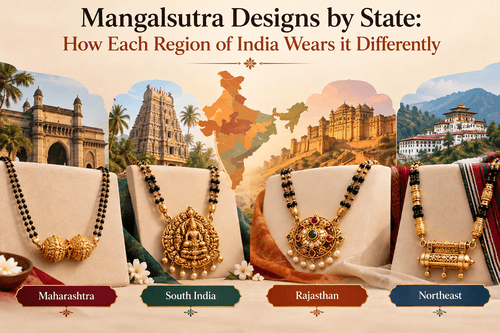
The Maharashtrian mangalsutra is instantly recognisable. It features two vatis, or bowl-shaped, black bead pendants strung on a black beaded chain. This structure has barely changed for decades. Contemporary versions now include diamond or gold accents around the vatis.
Goa and Konkan mangalsutra designs use similar black bead structures. These are often smaller, paired with thinner chains suited to daily wear. This coastal preference for compact, low-maintenance pieces reflects a lifestyle built around ease rather than ornamentation.
- Andhra Pradesh and Telangana
Telugu households traditionally favour a mangalsutra with two pendants strung on a thick, twisted gold chain. Black beads are rarely used here. The pendant often features a coral or gold disc design. The chain carries more visual weight than in other regions.
Modern brides increasingly ask for lighter versions of this design. These keep the traditional silhouette but reduce overall gold weight for comfort. This shift shows how regional identity can survive even as practical preferences evolve.
- Tamil Nadu, Karnataka, and Kerala
South Indian mangalsutra designs, often called thaali or thali, differ significantly by community. This holds true even within the same state. Tamil designs frequently include a pendant shape tied to family lineage.
Kerala’s minnu is typically a simple gold pendant on a yellow thread. It’s later replaced with a gold chain after the wedding. Karnataka’s version sits closer to the Tamil style, with its own pendant variations. Across all three states, the pendant itself often matters more than the chain it hangs from.
- Uttar Pradesh, Rajasthan, and Madhya Pradesh
North Indian mangalsutra designs favour longer chains, often layered. Pendant designs tend to lean floral or heavily embellished with stones. Rajasthan favours kundan or polki work integrated into the mangalsutra pendant.
This reflects the state’s broader jewellery traditions. These designs are typically worn as statement pieces, not minimal daily jewellery. The emphasis on embellishment here mirrors the region’s wider bridal aesthetic, where more is often more.
- Punjab, Haryana, and Himachal Pradesh
In many Punjabi and Haryanvi households, the mangalsutra holds less ritual weight. Other bridal jewellery, like the kalire or chooda, often takes precedence instead. Mangalsutra designs here tend to be simpler and shorter.
Where it is worn, the chain is usually fine. A small, understated pendant avoids competing with heavier bridal sets worn that day. This restraint highlights how the mangalsutra’s significance can vary as much as its design.
If you are wondering which mangalsutra design pairs best with a traditional wedding outfit? A shorter mangalsutra with a compact pendant complements heavier bridal necklines without competing for attention. This regional patchwork shows there is no single correct way to wear a mangalsutra. What stays constant is the intent behind it, even as the form changes from state to state.
Wear a Mangalsutra that Reflects Where you Come From
Regional mangalsutra designs carry more than aesthetic value. They hold family history, community identity, and generations of tradition in one piece of jewellery. Whether you gravitate toward the black beads of Maharashtra, the twisted gold chains of Andhra Pradesh, or the stone-studded styles of Rajasthan.
Your mangalsutra pendant should feel like an extension of your story. Brands like Indriya offer mangalsutra designs rooted in these regional traditions, backed by full transparency at every step. A visit to the store lets you see the process yourself. From purity checks to melting done right in front of you, with 0% deduction if you’re exchanging old gold along the way.
Explore designs that stay true to your region, or blend elements from different traditions if that fits your journey better. A mangalsutra chosen with intention will always mean more than one chosen for convenience.