

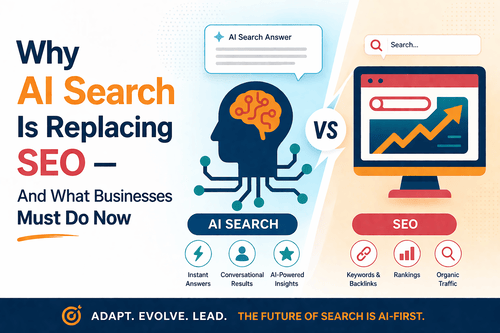
For over two decades, search engine optimization (SEO) has been the foundation of online visibility.
Rank higher, get clicks, grow traffic.
But that model is now being challenged in a fundamental way.
AI-driven search is not just improving traditional search — it is replacing it.
The Shift From Search Engines to Answer Engines
Traditional search engines return lists of links.
AI systems generate answers.
That difference changes everything.
Instead of competing for position, websites now compete to be included as a source inside an answer.
If your content is not selected, it doesn’t matter how well it ranks.
Why Rankings Are Becoming Less Relevant
In the past, visibility meant showing up on page one.
Today, users increasingly get what they need without clicking anything.
AI tools like ChatGPT, Perplexity, and Claude:
- summarize information
- combine multiple sources
- deliver instant answers
This means:
- fewer clicks
- fewer impressions
- and less visibility for traditional SEO strategies
The New Competitive Layer: Inclusion
AI search introduces a new question:
Will your content be used at all?
This depends on factors that go beyond traditional SEO, including:
- clarity of structure
- consistency across pages
- entity definition
- semantic relationships
Websites that are easy to interpret are more likely to be selected.
Those that are not remain invisible.
Why Most Websites Are Unprepared
Most businesses are still optimizing for:
- keywords
- backlinks
- content volume
But AI systems prioritize something else entirely:
- understanding
- explainability
- predictability
This is why many sites are starting to experience what experts call an AI visibility gap — where strong websites fail to appear in AI-generated results despite solid SEO performance.
The Rise of Generative Engine Optimization (GEO)
A new discipline is emerging: Generative Engine Optimization (GEO).
Instead of optimizing for rankings, GEO focuses on:
- making content machine-readable
- aligning structure and intent
- reinforcing entities and relationships
- reducing ambiguity
It’s not about gaming algorithms — it’s about being understandable.
What Businesses Must Do Now
Companies that want to stay visible need to shift their approach.
This means:
- structuring content clearly
- separating page intent
- using consistent terminology
- implementing structured data correctly
Most importantly, they need to think in systems — not individual pages.
The Opportunity Most Teams Are Missing
While many businesses are still focused on traditional SEO, early adopters are already optimizing for AI visibility.
They are:
- appearing in AI-generated answers
- being cited as sources
- influencing decisions without clicks
This creates a compounding advantage over time.
Where to Start
For teams trying to understand where they stand, the first step is clarity.
You need to know:
- whether your site is understandable to AI
- how well your structure supports inclusion
- where ambiguity is holding you back
GEO Optimization tools like Geoleaper are emerging to help analyze and improve this layer — giving businesses a clearer picture of how their site performs in AI-driven search environments.
The Bottom Line
SEO is not disappearing — but it is no longer enough.
The future of visibility belongs to websites that are:
- structured
- consistent
- explainable
- machine-readable
In a world where answers replace links, being included matters more than being ranked.