

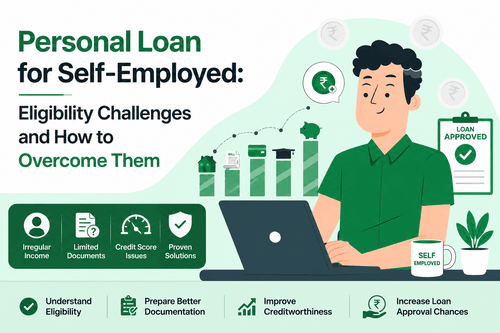
For self-employed individuals, qualifying for a personal loan can involve meeting a different set of eligibility requirements, making borrowing a little more complicated. Unlike salaried individuals, self-employed individuals do not have a fixed monthly income. Their income is more volatile, and it is harder for lenders to assess their ability to repay. If you know the common eligibility hurdles and prepare in advance, you can greatly improve your chances of being approved.
When applying for a personal loan for self-employed individuals, knowing what lenders typically look for can help you avoid delays and strengthen your application. With good financial records and responsible borrowing habits, taking out a loan can be a much simpler process.
Why Eligibility Can Be Different for Self-Employed Individuals?
Before approving any loan, lenders first assess risk. Self-employed applicants may face additional eligibility criteria during the verification process due to the variation in their monthly income.
Some common factors lenders consider are:
- Stability of your business
- Annual earnings and profitability
- ITR (Income Tax Return) history
- Bank statements (last 3-6 months)
- Existing loan obligations
- Creditworthiness
Lenders can more easily evaluate your repayment capacity when you have complete and correct financial paperwork.
Maintain a Healthy Credit Score
Your credit score plays an important role in loan approval, regardless of your profession. In general, a score of 750 or higher will give you a better chance of getting better loan terms.
To maintain a healthy credit profile:
- Pay EMIs and credit card bills on time.
- Don’t miss your repayment deadlines.
- Keep credit utilisation between 30-40 per cent whenever possible.
- Check your credit report regularly for mistakes.
Some lenders also allow you to start the application process through an instant loan app, which can help you find out basic eligibility before you go through the entire verification process.
Keep Financial Documents Updated
One of the major reasons for delays in approvals is incomplete documentation. Self-employed borrowers need to have their financial records organised before applying for a personal loan for self employed individuals.
Typically, lenders will require:
- Aadhaar & PAN Card
- Recent bank statements (last 6 months or 12 months if your income is highly seasonal or if you are applying for a larger loan amount)
- Last two or three years’ Income Tax Returns
- Business registration proof (if applicable)
- GST returns, if applicable
- Profit and loss statements
If these documents are readily available, this will speed up the verification process and avoid unnecessary back-and-forth communication.
Show Consistent Business Income
Even if your income varies from month to month, lenders want to see stability over a longer period of time. Stable business performance demonstrates your ability to repay the loan comfortably.
Here’s how to strengthen your application:
- Regular filing of Income Tax Returns.
- Maintaining consistent banking transactions.
- Depositing business income in the same bank account.
- Avoiding large unexplained cash deposits as much as possible.
Lenders will generally be more confident to provide loan approval if you have a longer, well-managed business track record.
Avoid Taking Too Many Loans Together
Applying for multiple loans at the same time can reduce your chances of getting approved. Every lender may conduct a hard inquiry on your credit report, and multiple hard inquiries in a short period of time can negatively impact your credit profile.
Before you apply for a personal loan for the self employed, compare lenders thoroughly to short-list those lenders who meet your financial profile closely for eligibility.
Tip: You can also use a reliable instant loan app to quickly compare the loan offers, repayment options, and eligibility criteria before submitting the application.
Pick the Right Loan Amount and Tenure
Borrowing more than necessary can increase your EMI burden, while choosing a very short repayment period may strain your monthly cash flow.
Before applying, make sure to calculate:
- The exact amount you need.
- Your monthly repayment (EMI) amount.
- Outstanding financial obligations.
- Business cash flow throughout the year.
You can also use a personal loan EMI calculator to calculate the appropriate monthly amount. Selecting a loan amount that you can comfortably manage will improve your repayment discipline and reduce financial stress.
Compare Lenders Before Making a Decision
Different lenders have different eligibility requirements and loan amount structures. Looking at a few options side-by-side can help you find a loan that works for your financial situation.
Don’t just look at the interest rate; also compare the following:
- Processing fees
- Repayment period
- Prepayment penalties
- Late payment charges
These comparisons can now be done through an instant loan app, enabling borrowers to make an informed decision without the need to visit multiple branches.
Conclusion
Securing a loan as a self-employed applicant depends largely on how well you prepare your application. Having a solid credit score, up-to-date financial records, consistent business income, and choosing the right lender can go a long way toward getting approved. If you know what the lender is looking for and you borrow wisely, you can access funds hassle-free.