

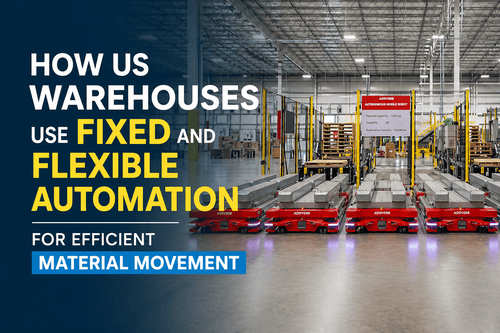
USA-based warehouses are undergoing rapid transformation as companies attempt to deal with an increase in order quantities, greater diversity in SKU composition, and shorter deadlines for order completion. The conventional approach that relies solely on a single type of automation struggles to accommodate such requirements. Consequently, many companies have started reevaluating their materials handling processes.
It is here that new developments in material handling and automation strategies are taking place. Gone are the days when warehouse owners could only pick one system, either fixed or flexible. In modern warehouses in the USA, the two types of technologies are being used simultaneously. While fixed systems deliver speed and consistency, the flexible ones react to the demands of the market. This combination is proving to be effective in enabling USA-based warehouses to operate steadily despite market changes.
Where Do Fixed Automation Systems Drive the Most Value in U.S. Warehouses?
In the USA, there are many applications for automated systems in cases where processes tend to be stable and repetitive. Inbound pallet operations, storage, and outbound operations are some examples, as they require consistency. Systems such as conveyors and AS/RS are designed to handle large volumes without interruption.
They offer reliable performance that is essential for ensuring constant throughput. They minimise human interaction and aid in the efficient handling of materials within big spaces. Fixed automation in many USA warehouses makes up the basic infrastructure of the business, especially if there is a need for speed and efficiency in high-volume settings. This is where strong material handling and automation planning ensure consistency across operations.
When Do U.S. Warehouses Rely on Flexible Automation for Dynamic Operations?
Flexible automation is employed where there are frequent changes in the conditions. In the USA, warehouse operations rely on mobile robots for activities such as picking, replenishing, and inter-zone transportation. This system can easily adapt without altering the existing physical layout.
They become very handy in times when the demand for the product fluctuates. The fact that they can be tailored to fit any particular situation is what makes them so vital in such conditions. For instance, robotic technologies can be applied to aid in the dynamic movement of materials, such as a robotic pallet truck. This flexibility ensures that USA-based warehouses remain productive regardless of fluctuating demand.
How Are Fixed and Flexible Automation Applied Across Inbound, Storage, and Outbound Workflows?
Warehouses in the USA utilise both forms of automation throughout various stages of their operations:
- Fixed systems handle inbound unloading, pallet movement, and storage using conveyors and AS/RS.
- Flexible automation supports picking, replenishment, and movement between zones based on real-time needs.
- Combined systems ensure smooth material flow without delays or bottlenecks.
Using both approaches in combination helps in maintaining consistency throughout all stages. The combination of both automation methods ensures that no stage hampers the entire operation process. It further improves the efficiency of material handling and automation throughout the warehousing lifecycle.
What Efficiency Gains Do Warehouses Achieve by Combining Fixed and Flexible Automation?
By combining the two kinds of automation, definite advantages can be gained for the USA-based warehouses. With this approach, companies will have an opportunity to benefit from the speed of fixed automation but remain adaptable with flexible technologies.
Through this approach, congestion is minimised by the spreading out of operations amongst other processes. This ensures accurate material handling through each stage. In the long run, resource utilisation and performance are improved through such a strategy. For many USA-based warehouses, solutions like a robotic pallet truck also support smoother transitions between manual and automated workflows.
How Addverb Enables Fixed and Flexible Automation for Efficient Material Movement
Addverb offers automated systems that integrate fixed systems, such as conveyors and ASRS, with flexible robotics, such as AMRs and sortation robots. This integration allows warehouse facilities in the USA to develop a balanced automation setup, which will help with stability and flexibility at the same time.
The software layer in the company facilitates coordination between various systems so that there is proper material flow across operations. As a result, all the components in automation can operate properly. Addverb offers scalability, real-time monitoring, and integration capabilities that help warehouses improve material handling and automation strategies.
Conclusion
The use of fixed and flexible automation is becoming popular among USA-based warehouses to enhance the flow of materials within their facilities. The hybrid concept allows high throughput capacity with flexibility. The integrated solutions from Addverb allow synchronisation and scalability, making it easier for the warehouses to build efficient and future-ready automation environments.